Saturday, March 24, 2012

Ultraviolence

Speaking of violent books, I recently reread Burgess’ A Clockwork Orange for my tutorial.  And O my brothers, Your Humble Narrator would like to tell you it is a real horrorshow book, the kind thou ought to recommend to all thy droogs.   But, it’s not really all that amazing.  It’s good, to be sure, but not nearly as deserving as the praise it receives would suggest.

(As for the movie—just stay away.  Part of the problem this book has is that it spawned a feverish adolescent fantasy in the mind of Stanley Kubrick.  This is a case where the movie not only isn’t as good as the book, but if one sees the movie before reading the book, then it will be very hard to read the book on its own terms.)
Without a doubt, the prose is the only thing which really gives this book any chance of being worthy of attention.  It is a joy to submerse yourself into the jargon and style of the narrator (the original Your Humble Narrator).  From the inspired coinages to the mock Shakespearean style to the elaborate euphemisms for the ultraviolent acts of a depraved youth, uncovering what Alex means is a treat.  (The first version of the book I read had a glossary in the back to translate—that is the sort of innovation which utterly destroys a book like this.  If you are going to read it, just read it.)

The book is an exploration of the nature of Free Will.  Do we choose to do Evil?  How important is it that we preserve the ability to do Evil?  If we could condition Evil people to do Good deeds by making it so that the very thought of an Evil Act induced overwhelming physical revulsion, would that be a good thing to do?  If people are compelled to Act Properly because we had made it impossible for them to Act Improperly, then have we made society better?

The book tries to isolate why people have a hard time with the idea of determinism and free will.  People like the idea that they choose to do good things.  But, they also like the idea that they do not choose to do bad things, that when people do bad things it was somehow determined by  Forces Beyond Our Control.  What this book does is ask which of those two things is more important—is it more important to preserve the idea that we choose to do good or to alter the deterministic aspects of evil so that nobody will ever choose to do evil?  If we end up doing good because doing so is beyond our control, are we better humans?  But, if we want to preserve the idea that what makes us human is the ability to choose to do good deeds, then doesn’t it necessarily follow that we must celebrate the ability to choose evil (we don’t have to celebrate evil, but don't we have to celebrate the possibility of doing evil?)?

The biggest problem with the book is that it cheats in the end.  The original last chapter is an argument that Free Will triumphs, but since Alex chooses to Be Good in the end for no apparent reason, the book ends up reading like some fairy tale of evil youths maturing and becoming good members of society.  Dropping the last chapter (as was done in the original American publication) isn’t an improvement—then we end with an evil character whose evil is somehow stamped on his soul with no possibility of choice—which would also simply be a cheat.  In the end, it’s not clear that this book is really arguing anything.  Nice prose in the service of a Big Question but providing No Answer, not even a bad answer, just no answer at all. 

So, read it for the prose, which is a real joy.  But, don’t spend too long imagining it is a deep book.

Friday, March 23, 2012

The Hunger Games

F. R. Leavis (if I recall correctly) noted about Lady Chatterley’s Lover that is was a failure as a novel, but it did have a serious moral intent.  Since the novel did stand trial for obscenity (ah, how times have changed), this sort of critical discrimination is important.   The novel is pretty bad, the point being made (industrialization is soul destroying) has been done better elsewhere, and the prurient parts are tedious, but even still, to simply call the book pornography is really missing the point.  Moreover, to simply label it pornographic is rather ironic, since the point being made in the novel is that the rise of the Industrial Age has destroyed our ability to enjoy erotic attachments.

Enter The Hunger Games.

I bought the trilogy for Clara as a Christmas gift.  We both read it shortly thereafter, and  we both enjoyed the series.  The quick review:  nice idea, not well written.  The pitch is a mess: one part political thriller, one part action movie, one part romantic love triangle.  Clara clearly liked the second part the best, hated the third part, and did not understand the first part.  (Indeed, about halfway through the second book she was expressing sympathy for the Evil Emperor, which either means my daughter is an incipient totalitarian or does not understand political subplots (I think it is the latter, but I am a bit worried that this is a case of my desire altering my perception of reality).)

As a trilogy, it is also very uneven.  The first book is far and away the best.  It’s a lot like Card’s Ender’s Game in this respect.  The cleverness is all in the construction of this giant game, which is more than it appears to be.  But, once the scene pulls back and we start seeing more of the world beyond the Game, the storyline loses momentum, at times devolving into outright tedium.  (The comparison to Card isn’t entirely fair—the second and third books in The Hunger Games are good enough to merit reading, while the rest of Card’s cycle is just plain awful.)

So, for months now, I have been merely thought of these books as pleasant diversion over Christmas Break.  Then comes the movie.  The images of little fangirls screeching in anticipation is funny—obviously the love triangle works better on pre-adolescents than on their elders.  (Think Twilight.)  There was an amusing Wall Street Journal article about how the movie studio was trying to make sure adolescent boys would also go see the movie—they were worried no self-respecting 16 year old boy would want to see a movie in a theater packed with swooning 13 year old girls.  So, the trailers play up the images of people doing exciting things like shooting arrows.  Anyway, an amusing cultural phenomenon.  Or so I thought.

Then about a week or so ago, Janet started asking me about whether this book was really appropriate for children.  A book about a game in which children must kill each other on live TV for the enjoyment of the population at large did not strike Janet (or those to whom she had been talking ) as Age-Appropriate.  (I’m not sure what age would constitute the threshold for that premise, but that’s another matter.)   The first time she asked about it, I just shrugged it off.  But, when she asked a few more times, I figured I should really write up a review, explaining why the trilogy is not inherently immoral.  (Not that Janet will ever read the review, mind.  She doesn’t read this here blog.  On principle.)

The Hunger Games is like Lady Chatterley’s Lover (not a review the publisher is likely to put on the book jacket, by the way).  It is making a very serious moral argument in a flawed vehicle and the critics are focusing on the vehicle, missing the moral argument, and indeed, in an ironic twist, the critics are acting exactly the way that the Evil masterminds in the book want the ignorant population in the book to act.

The moral argument:  the constant spectacle of violence in the modern age is destroying our souls.  As we become increasingly desensitized to violence, the stakes need to be constantly raised.  (Have you watched TV recently?)  Not only have we become more accustomed to violence, we have developed a taste for watching violence for enjoyment.  (TV, anyone?)  The Hunger Games imagines the future:  a giant reality TV show with violence as the theme.  Survivor to Big Brother to Jersey Shore to the Hunger Games.  On top of that, the Evil Government has designed the Game so that everyone will have a rooting interest—in a nation divided into districts, contestants are chosen randomly from each district, so that everyone has a stake in hoping a contestant from their district, someone they may know, will win.  There is even an audience participation portion of the program, in which your district, provided it can raise enough money, can send aid to contestants during the Game.  Moreover, the Games are not some fair fight on a neutral battlefield, but are carefully crafted so that the drama will be enhanced.  One contestant is a great archer—OK, there will be a bow and arrows waiting to be found.  But wait, the contestant who is archer is now shooting people from afar—OK, we’ll give armor to the other contestants.  The rules keep changing as the game progresses, forcing new strategies at each stage. To win, one must not only be skilled, but resourceful and clever and able to adapt quickly.  One also must be ruthless.  The ultimate sporting event.

Ah, but wait.  Children are dying in this game.  Actually, children are being murdered by other children in this game.  Isn’t that horrifying?  Uh, yeah.  That’s the point.  The Evil government in the book wants you simultaneously to get absorbed in the Game and to think it is all a horrifying, terrible, monstrous game.   If you focus your attention on how terrible it is that these kids are dying and murdering each other, maybe you won’t notice that life outside the Games, the life everyone is leading on a day-to-day basis, is really shockingly brutal and horrifying.  In the world of the books, the government is a nasty totalitarian empire.  The population is being starved into submission by a ruthless police state.  And yet, when people complain about the life they lead in the book, and when people out here in our world complain about how violent the books are, it is the Games they mention, not the brutality of living in a totalitarian police state.  By diverting your attention away from the political, your anger has been diverted into a rather safe channel.

The books are unstinting in their depiction of the brutality of this society, and yet, we still just notice the Games.  The protagonist, Katniss, is a very unlikable character.  Clara hated her—in part Clara was hoping she would die in the Games so that the books could be about a character she liked.  (I suspect in the movie Katniss will be dashing and charming.)  The violence of the Games destroys the lives of everyone who participates, even the winners.  By the end of this trilogy, nobody is happy.  Even though the good guys win, nobody is happy. (Another thing that will undoubtedly be changed when the movie trilogy is finished.)  It is a field littered with lives which have been destroyed by the violence. 

But, can a book with a central plot line in which children kill one another be morally acceptable reading for children (or adults)?  Ask William Golding, or any of the myriad of teachers and parents who have assigned this book.  The Hunger Games is in another sense a modern incarnation of Lord of the Flies.  I have never heard of someone objecting that Jack's hunting of Ralph or the deaths of Piggy and Simon make the book morally unsuitable.  Everyone seems to acknowledge that the book's moral purpose is something other than the mere depiction of the brutal murder of Simon.
A serious moral argument, then.  A critique of the modern world.  So, why does anyone object?  For exactly the same reason that people objected to Lawrence’s book.  Some people read Lawrence for a cheap erotic thrill (indeed, one of my professors in grad school once announced he was reading the book for exactly that reason).  Some people read The Hunger Games purely for the violence.  Some people also read the trilogy for the love story.  Some people read it because everyone else is reading it.  Some people don’t read it at all.  Yet, in the end, why people read the book does not change the underlying moral seriousness of the trilogy.  
The Hunger Games a deeply flawed trilogy.  But, in more capable hands, it could have been extremely good.  And that is something you can’t say about most books written these days.  

Saturday, February 25, 2012

Making Star Wars Better

Wow.  I didn't think it would be so easy to turn Star Wars 1 into a great movie, but this guy nailed it:

(Btw, if you haven't watched Star Wars, like, 8 million times, then a) what's wrong with you?, and b) that video won't make much sense.)

Thursday, February 23, 2012

Book Art

I can't decide if this (more here) is Art or Kitsch.  But, I find it strangely compelling either way.  And if I was in charge of the Mount Holyoke museum, I'd arrange an exhibition.

Wednesday, February 22, 2012

Hipsters

“It’s impossible to fall off mountains you fool.”

If your response to the preceding is “Wow, man.  That’s deep.  Really deep,” then I have a book for you.  If you respond like any sane person and say “Uh, not only is that untrue, it’s a rather stupid mantra,” then sorry, No Book for You.

The Book:  Dharma Bums by Jack Kerouac.  The bit above is the high point of the tale.  It occurs when Kerouac’s alter ego is climbing a mountain and get scared he will fall off, and then realizes he shouldn’t have been scared.  Deep.  Seriously Deep.  Like Wow.  Metaphor for Life, you know.  200 pages of that and you have one seriously Deep Reflection on, like, you know, Life and Stuff.    You think I’m making this up?  No way, Man.  Let me quote the Master:
This is it. “Rop rop rop,” I’d yell at the weeds, and they’d show windward pointing intelligent researchers to indicate and flail and finagle, some rooted in blossom imagination earth moist perturbation idea that had karmacized their very root-and-stem….It was eerie.”
At this point, you have already rushed out to buy the book is some hallucinogenic haze or decided never to even think about reading this book. 

I read it for my tutorial this semester.  Each of the five students picked a book, I added a selection, and we’ll read those books this semester.  From that list, this was the book I was least looking forward to reading.  I read On the Road a few years back in a different tutorial and thought it was a tedious waste of time.  One the Road is better than The Dharma Bums, mostly, I suspect, because I read the former longer ago and so the pain of reading it has dulled.

In the discussion about the book, I gamely spent two hours trying to convince anyone in the tutorial that this book held the Secret of the Universe.  I failed.  Perhaps it is not their Dharma to see the truth that becoming a Dharma Bum holds such marvelous possibilities.  All the students seemed to think this book was just about a bunch of Losers in the 1950s who decided to pretend their Aimless Lives had Meaning.

(The students also made some disparaging remarks about hipsters.  This amused me:  Lily complains every time I listen to Vampire Weekend that it is Hipster Music.  I tell her I am a hipster, so it's OK if I listen to it.  She gets exasperated.  But, now I am puzzled:  is it OK to like Vampire Weekend, but not Jack Kerouac?)

One student seriously objected to the portrayal of women in the book.  Every woman in the book exists solely in order to have will sex with Our Heroes.  I tried to convinced her that this was the Dharma of those women; that to exist solely as sexual objects for the Dharma Bums was a Deep Meaningful experience, but she didn’t buy it.  Sigh.  My power of persuasion are lacking.

I did learn something from reading this book.  It is even easier than I thought to spin out an ersatz Buddhist philosophy and pretend you are saying something even when you know what you just said means nothing at all.  Once you realize you can’t fall off a mountain, your Dharma is realized to entail a self-actualization of a what we might ignorantly call a Soul screaming to abandon the Norms of a society which denies its Oneness.  Deep, huh?

My other odd realization:  Kerouac’s alter ego in this book spends time in a fire watchtower in the middle of nowhere.  It serves as a time for reflection.  The titular characters in Mark Helprin’s Freddy and Fredericka also spend time in a fire watchtower in the middle of nowhere reflecting on life.  Presumably there is a connection, but I’d have to reread Helprin’s book to figure out what it is.

Helprin's book, by the way is worth reading.  In fact, a few years ago, the Mount Holyoke News ran a feature on Professors and the Desert Island Test for books.  (It was not a long running feature, by the way—I was the first and last entry—I guess my answers were too dull to make the series last two issues.)  I was asked to pick three books to take to a desert island, but I couldn’t pick any three books—I had to pick one 1 book from my discipline, 1 book from the last five years, and 1 free choice.  The book from the last 5 years was the hardest choice—seriously, how many books from the last 5 years are you confident you would want to read over and over and over for years on end?  So, I picked Freddy and Fredericka because it fit the category and I really liked it, and I figured maybe some student would actually read it.  So, I’ll repeat the advice again:  it’s a really good book—well worth your time.  (The other two books are also worth your time, but were much more predictable choices.  (So predictable that I suspect that even if I didn’t say what they were, anyone could guess what I said—so to confirm your guess:  The Wealth of Nations, which is a massive work of philosophy with endless side notes and ruminations masquerading as an economics book—I’d rather read it over and over than Friedman and Schwartz’s A Monetary History of the United States.  The free book?  The Bible.  That answer had the virtue of a) being true—I really world take it—and b) being nicely scandalous for a publication at Mount Holyoke.))


Wednesday, February 15, 2012

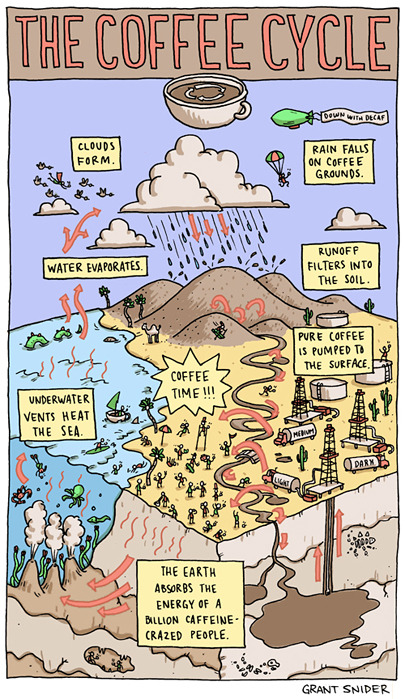
The Coffee Cycle

A Most Perfect Work of Art for your Edification.

Twilight of Descartes

Last Saturday, the Met broadcast its production of Gotterdammerung (Twilight of the Gods), the fourth and final part of Wagner’s Ring Cycle.  Ever since I first heard about this opera, I’ve wanted to see it, and now, thanks to the glories of Met in HD broadcasts, I have.  Altogether, it’s about a 15 hour long opera—the fourth part alone was a 6 hour event (including two intermissions).  The production was stunning, and the opera was every bit as amazing as I had always thought it would be.

So, what is the message, point, or conclusion of Wagner’s Ring?  I have absolutely no idea.  It is a sprawling, messy work.  Indeed, trying to forge some sort of coherent message here seems to me to be a Fool’s Errand.  It is the spectacle that matters, the recurring leitmotifs, the gods and dwarves and giants and dragons.  It is the rise of the man who knows no fear and the transformation of Brunnhilde from loyal daughter of Wotan to lover of Siegfried and the curse of Alberich and the failure of Wotan—all of these wrapped up into a massive, overwhelming, awe-inspiring tribute to…what?  One can, as Shaw did, spin this as some socialist tale showing the problem of the cursed lust for gold, but such an argument makes the opera too small.  If all of this is simply a footnote to Marx, then so what?  Every attempt to spin a moral tale makes this opera too small.

What I find intriguing about Wagner’s monumental mess is that it points to the idea of something which cannot be reduced.  A streamlined Ring, a Ring in which there was a coherent theme would be a very different thing.  And a much poorer thing.  Am I supposed to admire Siegfried or not?  Honestly, if that question could be answered, Siegfried gets smaller.  Am I supposed to mourn the Twilight of the Gods or not?  And again, to answer that is to diminish the opera.

In other words, this opera strikes me as the Triumph of Romanticism.  There is a wild, unknown, unknowable thing out there which is still True, but I have no ability to articulate it in cold, logical rational statements.  The Enlightenment dies in Wagner’s Ring.  The Gods and Dwarves and Giants and Heroes all Die in a great conflagration. And we are left with what?  The Wasteland. 

Monday, February 13, 2012

Five White Mice

In my continuing fascination with Stephen Crane, I recently read the section in his Library of America Volume entitled “The West and Mexico.”  This is a series of short pieces (mostly short stories, but some non-fiction) written between 1894 and 1900.

This section contains “The Blue Hotel,” which Mencken said was the greatest short story ever written.  I am not sure it is the greatest—but, then again, I have no idea which short story I would rate as the greatest, so maybe this is it—but, whether it is the Greatest or not, it’s really good.  Beautifully told, with a perfect punch line at the end.  I’m surprised I wasn’t forced to read it in high school—it comes with a ready-made high school paper topic.  It’s well worth a few minutes of your time to read this story.

The other stories in the section are also quite good.  The same thing that enables Crane to craft nice little poems, gives him the ability to craft an entire world in a short story.  The non-fiction bits were OK.  However it was pretty obvious reading the section as a whole, that Crane was using the non-fiction journalistic writing as a warm-up for the short stories.

The underlying theme is the question of fate.  How much of life is chance, how much is dictated by the actions of others and how much is in our control?  I haven’t read all of Crane, but it sure seems to me that there is a latent Calvinism underlying his work—we think we are acting, but we aren’t.  We think we are heading for a big showdown, but it doesn’t materialize.  We think we are passively observing events as they unfold, but we suddenly find our actions forming part of the narrative leading inexorably to conclusion.

How does one Act in the face of a current whose shape cannot be determined until after the fact?  Crane doesn’t seem to have much to say on that topic.  While it sure seems that action and inaction should lead to different outcomes, it isn’t at all clear in Crane that we have much of a say in the matter.  We act or don’t act, and then the result seems like it was a foregone conclusion before we ever thought about the problem.

Yet, somehow, Crane doesn’t seem fatalistic.  I haven't solved the problem of Crane, yet—but I still have several more novels and a lot of short stories to go.

Since that isn’t a very satisfying conclusion, I figured I would add a video.  I mentioned some months ago, I had bought Arcade Fire’s The Suburbs, but I wasn’t sure if I liked it.  After listening to it quite a bit, I am now happy to report, it’s a good album.  Here is the title song, which has an ambiguity suitable to the present post.

Friday, February 10, 2012

The Soul's Blood

Obviously, I am being terribly negligent toward this blog.  I’d plead that I have been actively engaged in a host of other activities, but I know in advance that such pleas of Being Busy will be unpersuasive to 1) those who Believe that the Present Blog should be one’s highest priority (a null set) or 2) those who have read the Annual Christmas letter and know that Your Humble Narrator never actually is Busy (a small set) or 3) those who really don’t care one way or the other (vast multitudes).  So, I will offer no excuses.

In the previous entry, I discussed the book I read on the way back from California.  As every attentive reader of this blog noted, this left open the question of which book I read on the way to California.  It was like a Reverse Cliffhanger—what happens Before?

Philip and Carol Zaleski, Prayer: A History

An amazing book.  Seriously amazing.  First off, the Zaleskis write with a remarkably fluidity and an incredible ear for a great anecdote.  For a book which sets out to detail every aspect of prayer, it was an extraordinarily smooth read.  Most religious books are either dense academic jargon or insipid feel-good exercises.  This is as good as writing about religion gets.

For the most part (the most part being about 90% of the book), the content was fascinating.  I’ve been rather devout ever since I can remember, and I have never learned as much about the nature of prayer as I did reading this book on a plane trip from the East to West Coast.  This was one of those books which opens up whole new vistas—it is very much akin to cutting down a bunch of trees which were obstructing a magnificent view.

The book is, as the title would suggest, a Grand Tour of Prayer.  Reading it, I was struck by how scientific the whole enterprise seemed.  Humanities types are not know for offering up scientific evidence, and scientists have great disdain of Proof by Anecdote.  But, after seeing the evidence marshaled in this manner, it was striking:  prayer exists is so many forms, in so many cultures, over so much time as a real experience of so many people that it would take a bizarre view of the world to say that there is nothing there.  Once you see the broad historical scope, there is a remarkable body of evidence that prayer is something fundamental and universal to the human condition.  Now why should that be?  Perhaps, prayer is actually something real?

Yet, the Zaleskis are also wonderfully quick to note, all prayer is not the same.  Buddhists and Christians are not doing the same thing when they pray.  Yet both do pray.  So, prayer is vastly more complicated than we tend to think.  Similarly, the heart of the book is a marvelous taxonomy of prayer: the refugee, the devotee, the ecstatic and the contemplative.  I’d never really thought about the types of prayer, but seeing it broken out like this revealed not just the omnipresence of prayer, but the complexity of prayer.

Now the quibble;  the only part of the book I thought was weak was two chapters in the last section, discussing prayer and healing and the efficacy of prayer.  It’s a foray into social science, and alas, it’s not great social science. There is a big difference between noting that prayer is something real by setting forth a wide array of anecdotal evidence for its existence, and thinking about whether prayer works by looking at a seemingly random small set of studies.

But, don’t let the quibble be anything other than a quibble.  This is a marvelous book for anyone who is at all interested in the nature of prayer.  And, much to my surprise, while it is clearly an academic book—I can easily imagine a class using this as a text—I have found myself praying vastly more often after reading it.  An academic book with practical effect.  Who knew such a thing existed?

Wednesday, February 1, 2012

When a True Genius Appears in the World

A few weeks back I had to take a trip out to California.  As I have noted here before, I carefully pick my Plane Books—books that look long and not necessarily all that thrilling, but which I really wish I had read.  Planes are the perfect place to read such books. 

This trip I made a horrible mistake in picking a book for the plane trip back.  It doesn’t seem all that hard to pick books which will meet the above criterion, but this time, I was way off.  In fact, I don’t think I have ever made a bigger mistake.

The book:  John Kennedy Toole’s A Confederacy of Dunces

The problem:  It was a fantastic book.  I would have ripped right through it even if I wasn’t on a plane.  I wasted a whole plane trip reading a book I would have devoured had I ever read the first page before now.  Indeed, my foremost thought when reading it was, “How in the world is it possible that I have never read this book before?”  That was coupled with, “Where in the world did I ever get the idea that this was one of those dreary, but potentially worthwhile, bits of literature?”  The answers to those two questions are undoubtedly linked, but I have no idea what those answers might be.

This book is funny, very funny.  And thought-provoking.  It is interesting, well written, and has some of the most memorable characters you’ll ever meet.  The main character, Ignatius J Reilly is a modern day Falstaff.  Take Shakespeare’s character, put him amongst the working (or non-working as the case may be) classes of New Orleans in the 1960s and you would have this book.  Brilliantly done.  The cast of supporting characters are also worthy of Henry IV—no small feat, that. 

It’s a sprawling book, with, I suppose, something akin to a plot line, but really a series of minor plot lines weaving in and out.  Uniting the plots is Ignatius’ attempts to navigate a word in which he doesn’t quite belong.  A slothful holder of a Master’s degree in English, holed up in a room in his mother’s house, we see Ignatius simultaneously trying to write the grand philosophical work to end all philosophical works—he runs out of steam every time he gets a paragraph or two or random musings down on paper—and looking for a job to help pay the bills so his mother doesn’t lose the house in which he resides.  Reilly is unsuitable for work—in exactly the same way the Falstaff would have been unsuited for a desk job.  Reilly is larger than work, he is larger than life, there is simply a vast Too Muchness about him.  You would not want to know Ignatius J Reilly; you would think he was an Absolute Loser because, well, he is one.  He Dreams Big, can’t muster the energy for even the most mundane tasks, and yet, despite being everything you would not want your kid to become, it is hard not to secretly, very secretly (you wouldn’t want anyone to hear you think this), admire him a bit because he just doesn’t care that the world does not fit him.  He chalks his misfortunes up to Fortuna, and…well, I was going to say moves through life, but “moves” conveys a bit more purpose than Ignatius is wont to display.

Throughout the book, the other characters serve as a foil for the problems of Reilly—we watch others struggling or giving up the struggle to fit into the world, none of them terribly successful at it.  As Reilly muses toward the end of the novel:

Once a person was asked to step into this brutal century, anything could happen.  Everywhere there lurked pitfalls like Abelman [a customer of the factory in which Reilly briefly worked], the insipid Crusaders for Moorish Dignity, the Mancuso cretin [a policeman], Dorian Greene [a rather campy homosexual], newspaper reporters, strip-teasers, birds, photography, juvenile delinquents, Nazi pornographers. And especially Myrna Minkoff [a wannabe 60s radical].  The consumer products.  And especially Myrna Minkoff [yes, he repeats that sentence—Myrna is a real problem for Ignatius].

It is interesting to think at the end of a novel like this:  how much do I try to fit into the world?  How much of what I do is a deliberate attempt to shape my life so that I seem at home here?  What would be different if I simply woke up every morning, firmly convinced, that the world should fit me, that world should modify itself so that it was at home with me?  Imagine that you really believed that, that you really did wander through life unaware that there was something odd about your attitude toward the world, that it was singularly odd that you actually didn’t understand why you should adapt yourself to the world.  It’s a strange thought experiment.

From there, one gets to wondering why the world is the way it is.  And reading this coming off a semester reading Southern literature in my tutorial, it’s easy to see how there is a logical progression from Faulkner and Agee to Toole. 

And yet…is the world really all that bad?  Is fitting into a world of work and polite social interactions really all that bad?  Are we really living lives of quiet desperation (OK, that’s a Northerner’s line, but even still, it fits)?  I’m not so sure.  I like my computer and my iPod and the easy ability to buy books.  I like microwave ovens and cordless drills.  And is modern industrial life really such a high price to pay for the marvel of being able to read news about the Raiders on the internet while living on the East Coast?